Premise. I have recently moved to Milan; it is autumn, and it is a mild day. I am sitting in a nice café in the Lambrate area, working on my laptop. Two women, both strikingly good-looking, walk in and sit down nearby. We start talking. It turns out they are sisters: one works in photography, the other in animation. “Animation!?” “Yes, yes… I am here with my sister, and look, I am actually online right now, hunting for material to assign my students on the subject. I want to find something clear, something essential.” At that point, I toss out a name: “Why not try Bendazzi? His website has all kinds of things these days that are hard to find anywhere else…” She looks surprised. “Oh! I do not know him! Let us have a look…” And from there, the conversation keeps going—hopefully to her satisfaction, for the discovery, but certainly to mine, for the tip.
Fast-forward to the present. When thinking about how I discovered Giannalberto Bendazzi’s work—a few months before the scene above—I owe my thanks to artist Leonardo Carrano and film historian Federico Rossin. They introduced me to Bendazzi’s latest book, Animation: A World History, which had just been published. This comprehensive 1,456-page, three-volume work reflects years of global scholarly research and charts animation’s history from its origins to today. Volume One covers the first three periods: before Fantasmagorie (Émile Cohl, 1908); 1908 to 1928; and 1928 to 1951, the so-called Golden Age. Volume Two continues with 1951–1960 (The Birth of a Style) and 1960–1991 (The Three Markets), while Volume Three concludes with 1991–2015 (Contemporary Times).
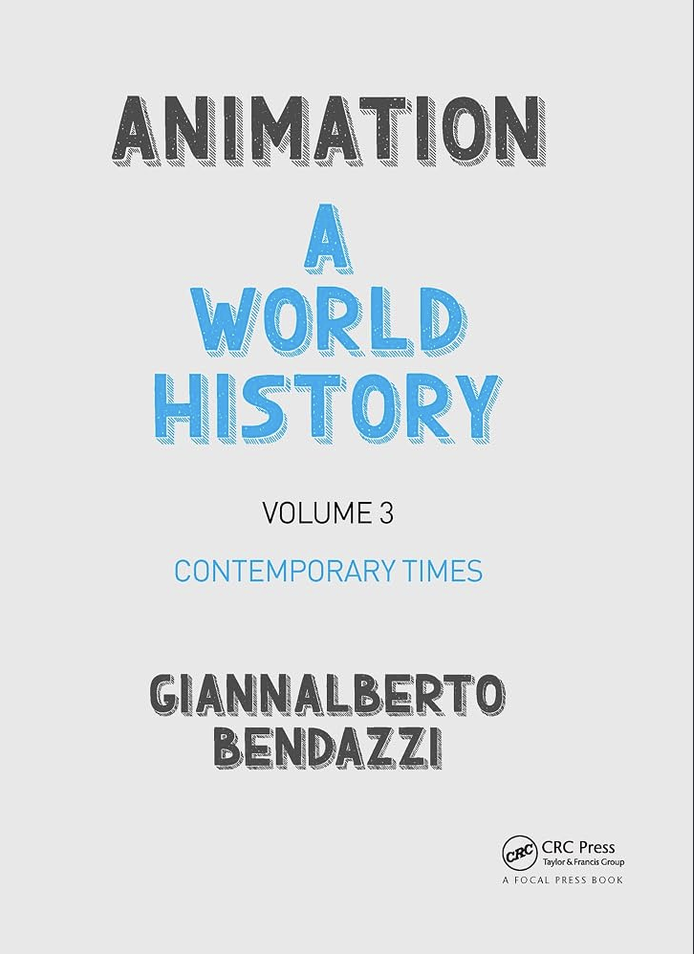
In short, it is a genuine scholarly achievement, enough to spark curiosity and prompt you to learn more about the author. So, who exactly is Giannalberto Bendazzi?
Although his work remains mostly unrecognized in Italy, online sources such as his biography and publications indicate that he is considered one of the top animation scholars with an international reputation. His official website, www.giannalbertobendazzi.com, offers valuable insights: it highlights his journalistic, self-taught background (born in 1946) and his academic career both in Italy and abroad, and it provides free access to download and read his out-of-print works, giving a full view of his careful methodology and the importance of his contributions. The publication of this trilogy further boosted his prominence, making it appropriate to engage with him directly and have him discuss his work.
Bendazzi on Bendazzi. How would you define yourself?
I consider myself an all-around film critic because I have written about both animation and live-action cinema, and I hope I have contributed valuable insights to both areas.
Could you please elaborate on the origin of this trilogy and its structural organization?
The book grew out of my earlier work, Cartoons, which has been out of print in Italian for a long time but continues to sell steadily in English. My publisher asked me to update it, as by 1994 it had begun to feel outdated. There was an excess of new material, many new names, and a genuine need to illuminate aspects that had previously been overlooked. I ultimately signed the contract with the publisher in 2006, under the condition that I write the book in English. This approach proved to be a more practical means of reviewing all the content.
The research process was lengthy and intricate, partly due to personal health considerations. For certain regions or countries that were difficult to access, such as Uzbekistan or Tajikistan, and for specific filmmakers about whom I might lack objectivity for various reasons, I chose to collaborate with trusted individuals—many of whom are personal acquaintances, and some of whom are former students of mine. Nonetheless, I personally edited their contributions to ensure stylistic consistency, as this project’s editorial architecture is genuinely complex.
This book is inherently challenging to compile because of its notes and detailed sections. It demanded considerable patience and excellent content-organization skills. I believe that structure is the most vital aspect, as it turns this work into a significant history and a clear, cohesive narrative.
It is almost like an encyclopedia as well, given the recurring entries, such as the breakdown of chapters and sections by continent and country, the detailed boxes, and the explicitly outlined roles of the collaborators.
Yes, I would have preferred to do more intellectually engaging work, and I might well have been capable of it; however, I had to accept a primarily excavation-focused role, following whatever became apparent. Essentially, we are at a point where acting as an “intellectual” is not feasible due to the ongoing lack of awareness of animation history, even among industry professionals.
Could you please provide your perspective on animation studies, specifically comparing the Italian scene with the international landscape?
Significant work remains to be done in the field. The Society for Animation Studies, established in 1987, continues its efforts; however, substantial gaps persist within the discipline. Each year, new publications on animation are released, yet they are predominantly monographs focused on well-known figures—be it Hayao Miyazaki, Tex Avery, or others.
The most substantial limitation, however, is the scarcity of translations. This is evident even with fundamental texts, which are often unavailable in widely spoken languages such as English or French. For example, I am aware that numerous valuable books have been published in Russian; I only became aware of them through a Russian acquaintance who managed to acquire and review such works. Nonetheless, such publications remain scarce and face difficulties in reaching a broad audience.
This issue is particularly pronounced in Italy, where English functions as the lingua franca, and scholarly works are primarily written or translated into English. Historically, French served this role; however, material written or translated into French has largely remained confined to French-speaking regions.
The Bendazzi method: is it perhaps a form of anthropology? In other words, how should animation be appropriately studied?
I approached this subject in the way that felt most fitting because, unlike a conventional historian with access to extensive written sources such as official documents, soldiers’ letters, or military tribunal transcripts, I could not rely on comparable material, since animation leaves few traces of its own. This makes direct engagement with creators crucial. From the early 1970s, I began by questioning animators and immersing myself in their environment: festivals, daily work, press debates, and so forth.
In effect, I became part of the global animation community and was recognized as a genuine member. I witnessed events firsthand and interacted with creators, either experiencing these moments directly or hearing about them from those involved. Without these personal accounts, there would not be enough to build a credible history.
Of course, my account is inherently personal and subjective, as objectivity is impossible in this field. My aim has been to be honest and transparent about my perspective and starting point.
Animation and History: Can animation provide tools not only for depicting but also for understanding contemporary history?
Indeed, when animation reaches a broad audience, especially when it is not solely an auteur-driven work, it responds to specific social needs and, in doing so, mirrors the condition of society at large. Permit me to illustrate with two examples.
The first concerns American superheroes, who unmistakably represent the President of the United States. They embody the perception of the President as “one of us,” but endowed with greater strength—a figure expected to resolve societal issues on our behalf, address problems, and enhance our quality of life.
The second example concerns the exaggerated scale of Japanese robots, equipped with secret, often near-magical weaponry, standing against the planet’s annihilation by extraterrestrial forces. This can be interpreted as a global manifestation of the trauma inflicted by the atomic bomb dropped on Japan during the Second World War.
Ultimately, returning to the trilogy, is there anything you would like to add?
Animation is a language, a fundamental medium for telling fairy tales to children. Yet it is equally capable of producing works of the highest artistic merit. In particular, auteur animation is an essential part of global culture and warrants recognition and appreciation. I regard animation as a product of human ingenuity that remains, to this day, insufficiently disseminated, often misunderstood because of ingrained clichés, and inadequately preserved. It is essential to address these issues, and one effective way to do so is to understand its history.
Furthermore, this trilogy is designed to be a durable academic resource—its relevance is expected to endure for thirty years. This is not merely an assertion; the earlier English edition of Cartoons sold consistently for twenty-two years, from 1994 to 2016.
Fundamentally, Animation: A World History is a foundational text.
This is a revised version of an article originally written in Italian and published in Alias, the weekly magazine of Il manifesto.


Leave a comment