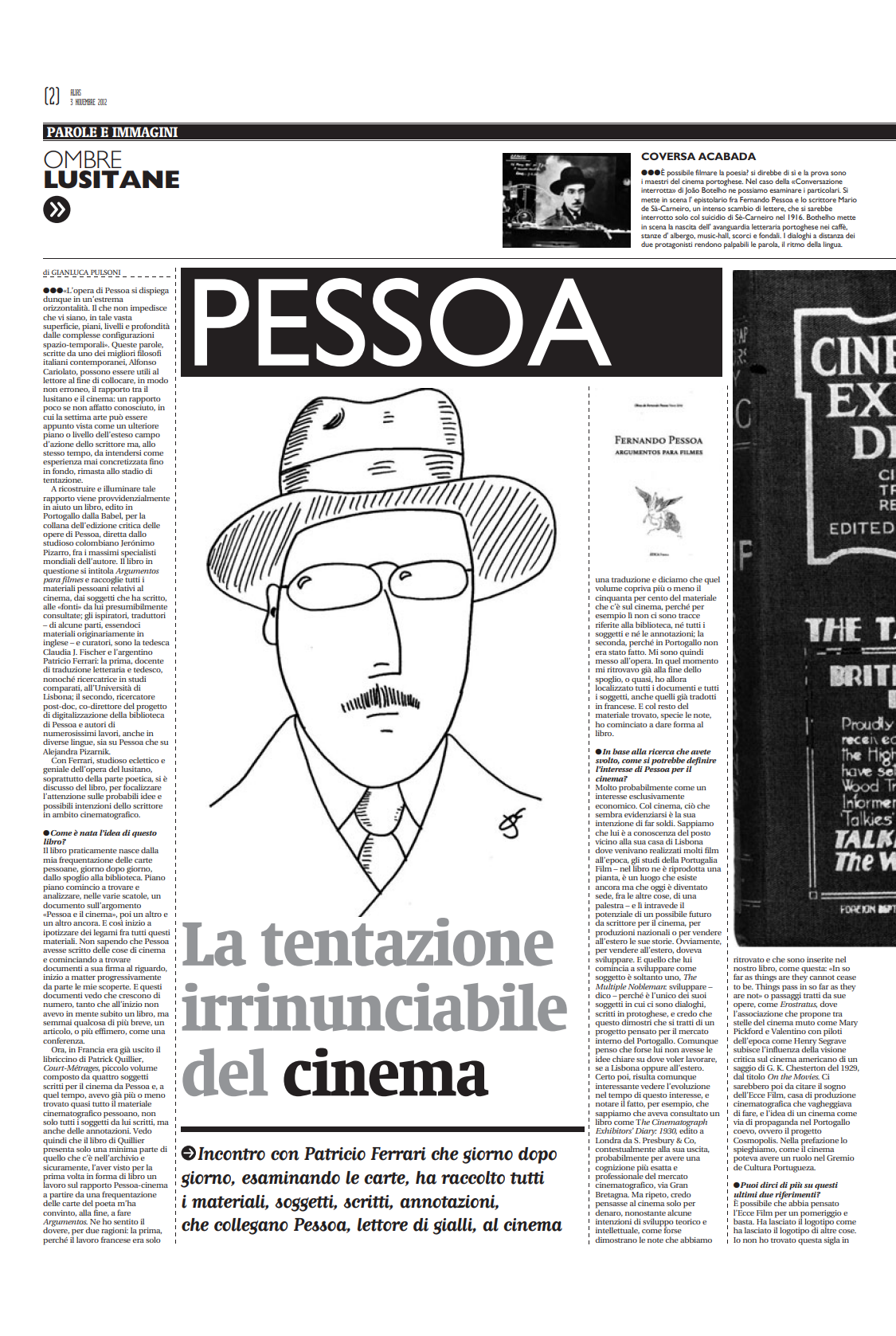
“Pessoa’s work thus unfolds along an extreme horizontality. This does not prevent that vast surface from containing planes, levels, and depths with complex spatio-temporal configurations.”
These words, written by the Italian philosopher Alfonso Cariolato, may help the reader correctly situate the relationship between the Portuguese writer and cinema: a little-known relationship, in which the seventh art can indeed be seen as a further plane or level within the writer’s vast field of activity, yet at the same time should be understood as an experience never fully realized — one that remained at the stage of temptation.
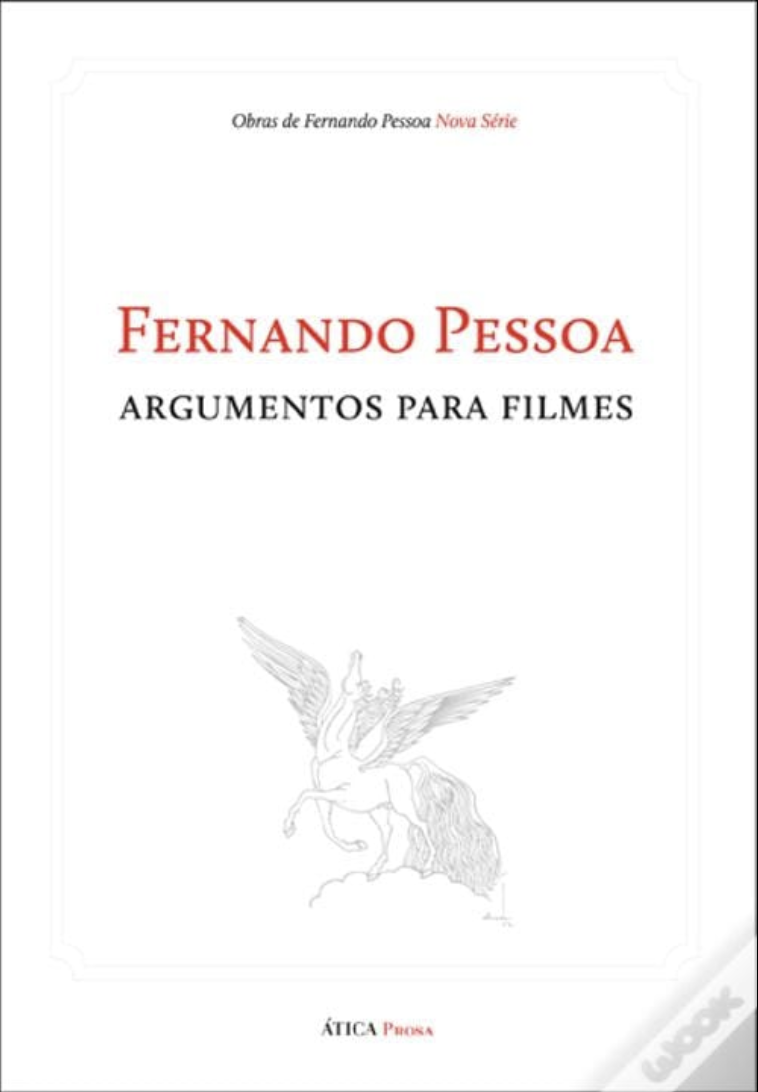
One book comes to our aid here: Argumentos para filmes [i.e., Film Scenarios], published in Portugal by Babel as part of the critical edition of Pessoa’s works, directed by the Colombian scholar Jerónimo Pizarro — one of the world’s finest specialists on the author. It gathers all of Pessoa’s cinema-related material, from the scenarios he wrote to the “sources” he presumably consulted. The translators and editors are the scholars Claudia J. Fischer and Patricio Ferrari.
We met with the latter to discuss the book and to focus on the writer’s possible ideas and intentions regarding cinema.
How did the idea for this book come about?
The book grew out of my daily engagement with Pessoa’s papers, which I examined at the library. Gradually, I identified and analyzed documents stored in various boxes, starting with one on Pessoa and cinema and then finding additional materials. I had not known that Pessoa had written about movies. As I uncovered more documents bearing his signature on this topic, I began hypothesizing possible connections among them and set my discoveries aside. At first, I did not think of this as a book but as a shorter work—perhaps an article or an even more ephemeral project, such as a conference presentation.
In France, Patrick Quillier had already published a small book titled Court-Métrages [Short Films], which consisted of four scenarios Pessoa had written for the cinema. By then, I had already gathered most of Pessoa’s cinema-related material — every scenario, along with various notes. I realized Quillier’s book represented only a small portion of what the archive held. Seeing, for the first time in book form, a work directly engaging with Pessoa’s papers on cinema ultimately convinced me to create Argumentos. I felt compelled to do so for two reasons: first, because the French publication was merely a translation and covered roughly fifty percent of the existing cinema-related material — it included nothing related to the library, only some of the scenarios, and none of the notes; second, because no similar work had been done in Portugal. I then set to work: by that point I had almost finished reviewing the archive, so I located all the documents and scenarios, including those already translated into French. With the remaining material I had found, especially the notes, I began shaping the book.
Based on the research you carried out, how would you define Pessoa’s interest in cinema?
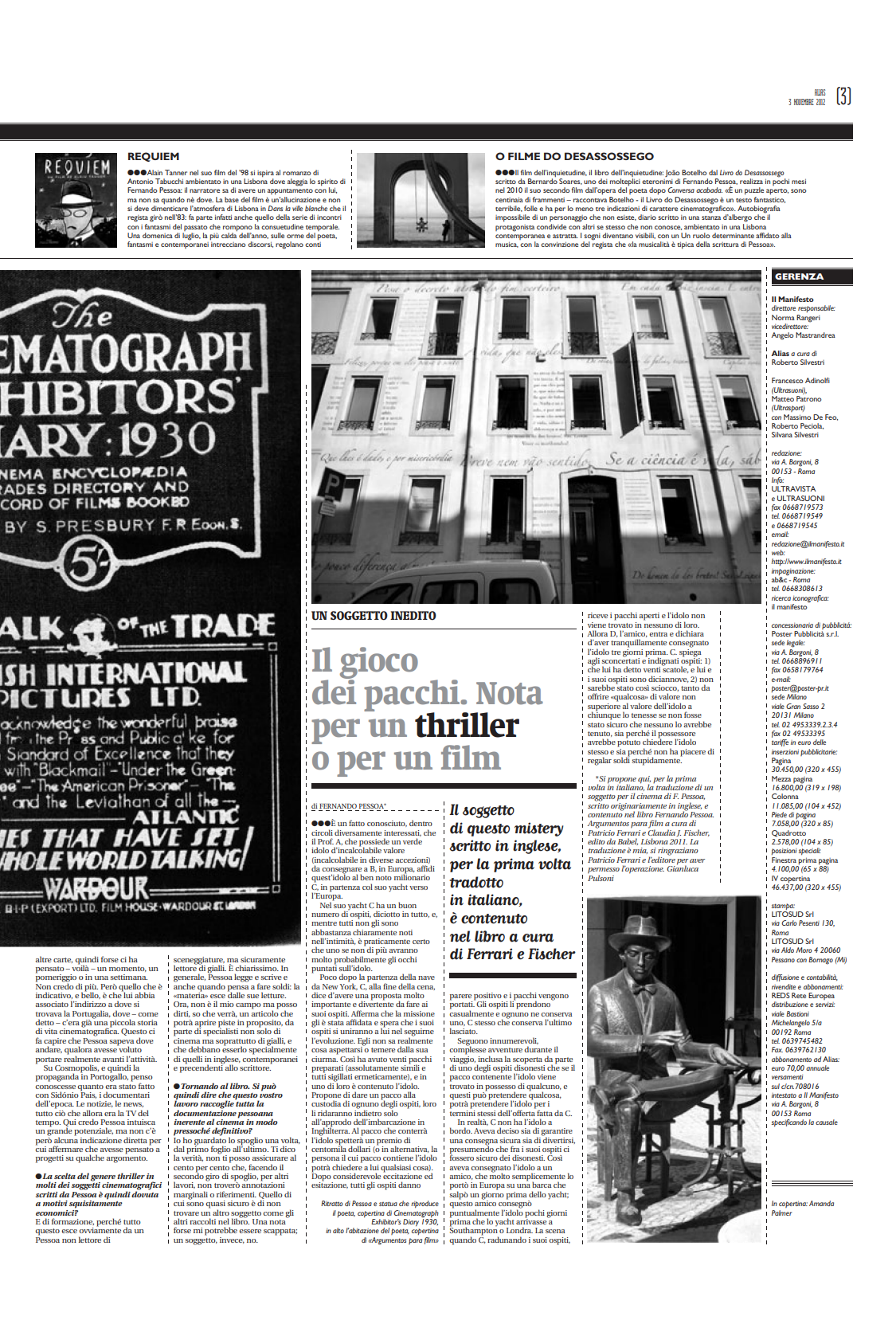
Most probably as a purely economic interest. What stands out about cinema is his intention to make money. We know that he was aware of the place near his house in Lisbon where many films were made at the time, the Portugalia Film studios — the book reproduces a floor plan of it; the site still exists today, but has now become home to, among other things, a gym — and there he glimpsed the potential for a possible future as a screenwriter, whether for national productions or to sell his stories abroad. Obviously, to sell abroad he needed to develop them further. And there is only one scenario he actually began to develop, The Multiple Nobleman: I say “develop” because it is the only one of his scenarios that contains dialogue, written in Portuguese, and I believe this shows it was a project conceived for the domestic Portuguese market. In any case, I think he perhaps didn’t have a clear idea of where he wanted to work, whether in Lisbon or abroad. What is certainly interesting, though, is to trace how this interest evolved over time, and to note, for instance, that we know he had consulted a book such as The Cinematograph Exhibitors’ Diary: 1930, published in London by S. Presbury & Co., right around the time of its release — probably to gain a more precise, professional understanding of the film market, via Britain. But I repeat, I believe he thought about cinema purely in terms of money, despite some intentions toward theoretical and intellectual development, as perhaps shown by the notes we found and included in our book, such as this one: “In so far as things are they cannot cease to be. Things pass in so far as they are not” — or passages drawn from his own works, such as Erostratus, where the association he proposes between silent-film stars like Mary Pickford and Valentino and contemporary racing pilots like Henry Segrave shows the influence of the critical view of American cinema found in a 1929 essay by G. K. Chesterton titled On the Movies. One should also mention the dream of Ecce Film, a film production company he fantasized about setting up, and the idea of cinema as a vehicle for propaganda in the Portugal of his time — that is, the Cosmopolis project. In the preface, we explain how cinema could have played a role within the Gremio de Cultura Portugueza [Portuguese Cultural Guild].
Can you tell us more about these last two references?
It’s possible that he thought about Ecce Film for just one afternoon and no more. He left behind the logo, just as he left behind logos for other things. I haven’t found this particular mark in any other papers, so perhaps he thought about it — voilà — for a moment, an afternoon, or at most a week. I don’t believe it was any longer than that. But what is telling, and rather lovely, is that he associated the address with Portugalia, where — as I mentioned — there was already a small history of cinematic activity. This suggests that Pessoa knew exactly where to go, had he actually wanted to pursue the venture in earnest.
Regarding Cosmopolis and propaganda in Portugal, I think Pessoa was aware of the documentaries produced during Sidónio Pais’s time. He appeared to acknowledge cinema’s potential, but there’s no clear evidence that he had any specific projects on particular topics.
Is Pessoa’s frequent use of the thriller genre in film scenarios driven mainly by financial reasons?
Pessoa usually didn’t read screenplays but was clearly a fan of detective novels. Overall, he read and wrote frequently, and even in his efforts to earn money, his reading shaped his work. Though I’m not an expert, I expect that some cinema scholars—especially those focusing on detective fiction—will soon publish an article on English detective stories from the author’s time and earlier periods.
Referring to Argumentos para filmes again, can we then say that your work consolidates nearly all of Pessoa’s cinema-related documentation into an almost definitive collection?
I reviewed the entire archive from beginning to end. Honestly, I can’t guarantee that, upon a second review of different projects, I won’t overlook some marginal notes or references. However, I’m confident I won’t encounter a scenario similar to those already documented in the book. A note might have escaped my attention, but a scenario, I believe, would not.
 ISTRUMENTI
Leave a comment