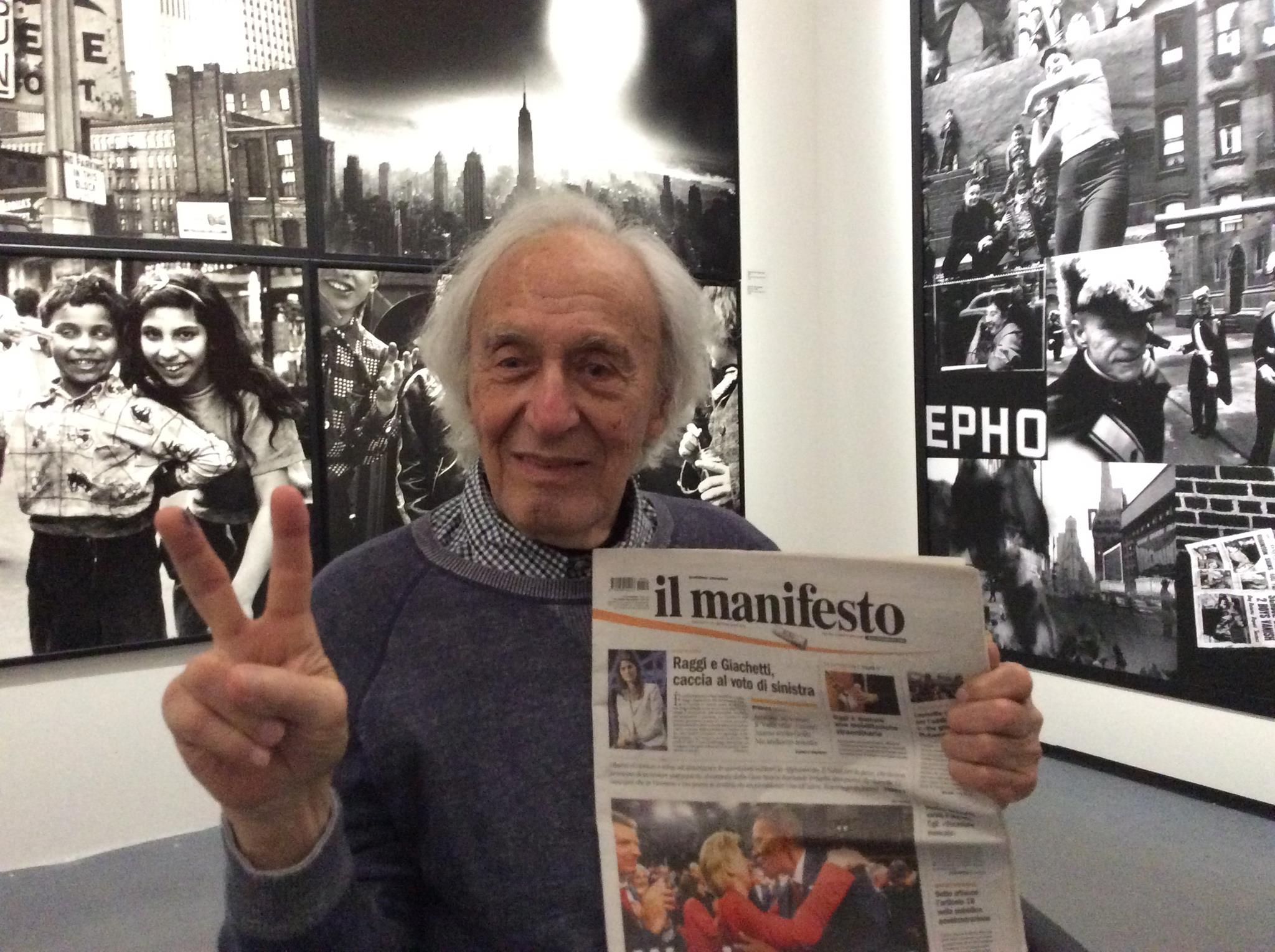
A meeting with someone like William Klein is definitely a special occasion.
He is friendly and generous with his time, spending as much time with us as he did with previous visitors, including those from Rai and Vogue Italia.
He keeps up the playful tone that has often characterized him (“Are there still communist newspapers around?” — that’s roughly how he broke the ice).
What follows is an edited version of the interview we conducted before the Milan exhibition opened. In translating it, we aimed to preserve its conversational tone as much as possible.
Who is William Klein? We ask because you are a painter, and a photographer, and a filmmaker…
I’m an artist. And I think that today an artist has to be a photographer, a painter, a director — I think that’s normal. All these things are within reach now, I mean, you can do everything. Being, say, only a painter isn’t enough.
Can you tell us who influenced you in your work?
Fernand Léger. He was someone who really embodied what, to me, an artist should be. He was interested in the collective. He made murals; he invited artists into his studio. I used to go to his studio — I spent time there — and he’d tell all these young painters, men and women, who wanted to become artists, to find something that spoke to both life and art. So, there, you’re asking what my heritage is? It’s him, as a model, since — precisely — he embodied what an artist should be: someone not confined to a single field.
And Chris Marker? We know he was also important to your work, especially for the New York book.
When I shot the New York photographs and showed them to an editor based there, he told me, “These photographs are shit! We can’t publish them; they’re really anti-American.” So I had no luck publishing the book there right away.
That said, I’d seen some books published in France, a paperback series called Petite Planète: they were travel books, meant for young people (with titles like “How to Survive Istanbul” and “How to Survive Norway”). So I figured the people behind that project were the ones I needed to get in touch with, and I called the Seuil publishing house in Paris to speak with Marker, who’d created the series. I showed him my New York photos, and he told me they’d publish them as a book at Seuil, just as I wanted. And he added, “If they don’t publish it, I’m done with this publisher!” — because he’d grown restless being there, and any excuse was a good excuse to threaten he’d walk. But at the publishing house they were very attached to him, because he was always around — he’d answer, for instance, people who sent in photos like I did — and because, I mean, they knew they had Chris Marker. He was a young writer; he’d already made films — Dimanche à Pékin (1956) and Lettre de Sibérie (1957) — so, there, he was someone who helped me at the start. My first book was published by Seuil, thanks to him, with the subtitle “Album Petite Planète 1”.
Chris Marker really was my friend and another model who, in the end, embodied what an artist should be.
Regarding your photographic projects focused on specific cities, beyond the most renowned locations—such as New York and Paris—could you share insights about the other cities? For example, could you provide some information regarding your work on Moscow?
The Moscow book was a kind of accident, happenstance.
I was interested in photographing the world, and so also the Russia of the Communist period. Now, I wasn’t a tourist, a passing observer — I was, and am, a photographer. So I wanted to turn what I saw into objects, photographs. So when I got the chance to go to Russia, to Moscow, I thought, yes, I could make a book out of it.
What’s your opinion of “street photography” today?
The street is very simply where things happen. It’s drama, spectacle, graphics, surprise — so there’s a whole lot you can say by photographing the street.
And what about political engagement for an artist?
I think that if you have the chance to express yourself across different fields — graphics, photography, other media — you should make sure to put the talent where your mouth is.
I think that if you’re interested in life, you have to reckon with the “public” side of photography, of film, and so on. I think that’s normal — in fact, indispensable.
Let us now discuss your films. We wish to start with an observation: in your sports documentaries — including the one about Muhammad Ali and the one about Roland Garros — you have consistently adhered to a documentary approach, which is not the case in your other projects.
Yes, true, but you know, my film on Ali isn’t a film about sport — it’s a film about a person who happened to be a boxer and who had a lot to say.
If that’s the case, we’d like to learn more about your Ali.
He’d met Malcolm X, a spiritual guide, someone who had a vision of America and of life in general.
Let’s say his great tragedy was those goddamned “Black Muslims” who took Malcolm away from him. If Ali had been able to keep going under Malcolm X’s guidance, he’d have been a different Ali — it would have been something wonderful. You know, America never judged the boxer on his own terms.
I made a film in Algiers; I filmed the Pan-African Festival (1969), and there I saw dances and artists and actors and actresses, people who came from the jungle, small communities, and all of them knew Ali! He was the most famous person in the world. When he won the championship, everyone was struck by the role he played as a symbol and spokesman at the time. There’s one more thing that America didn’t understand about Ali, which is that he really could have become an ambassador for the world, for Africa, for everything. He could have been so many things, and in fact he was so many things — think, for one, that he was certainly against the greed of the power structures.
He was a genius.
I watched Ali’s funeral on television, and I saw Black people coming out of their houses to lay flowers on the limousine carrying the casket. I saw a combination of love and respect, because… I mean, these people had never brought flowers in their whole lives! But in this case, they came out of their houses — huge crowds of people with flowers in their hands, flowers for the casket that they placed very carefully. I mean, they didn’t throw them, the way it happens in a lot of other cases. They laid them on the roof of the car. There was something that touched the minds and hearts of so many people.
So yes, he could have had a great role — and then think of the illness that struck him — but basically, yes, he played an important role for what he was, regardless.
Besides your work on Ali, we’d love to hear more about your other films, especially The French. Could you share a bit about it?
I’ve always been a tennis fan, obsessive, let’s say. I was also a good player.
Oh really? [My astonished exclamation prompts him to give me a sly look, a mix of surprise and irony, but perhaps — in the end — he was just pleased with himself].
Sure, I even won. I was, let’s say, deeply into the idea of anguish and fear that’s part of tennis. Playing a tournament like that — Roland Garros — really is something that wrecks you, and so I related to it by staying close to the heroes I knew. I wanted to be near people like Borg, McEnroe, and others.
Could you tell us who your favorite tennis player is?
Yannick Noah.
Why?
The idea of him, a small barefoot kid in Cameroon hitting a tennis ball, discovered by Arthur Ashe — Ashe is a hero to me too; he won Wimbledon beating Connors — it’s a beautiful thing.
Noah then went on to win Roland Garros, one of the very few French players to do so.
Final question: among your films, which one is your favorite?
I think it’s the one on Muhammad Ali!
[We both laugh].
I love Muhammad Ali. I mean, how do you not get close to a figure like that — someone who’s Black, who’s a world champion, who has historical significance — except by making a film?
I mean, after all, I made this film, and I was close to him, but we never really spoke the same language. He was this Black kid raised in Louisville, and there was no way a Jewish kid from New York could be Ali’s buddy. It just wasn’t possible. You could be accepted by him, but you didn’t become his friend.
This is a revised version of an interview originally published in Alias, the weekly magazine of Il manifesto.


Leave a Reply