For those who appreciate writers who are as relentless in their analysis as they are insightful about the human condition, Peter Weiss (1916-1982) is a familiar name. He is best known for his work as a playwright, including Marat/Sade (1963) and The Investigation (1965). Additionally, Weiss’s role as a novelist is noteworthy, especially his powerful trilogy The Aesthetics of Resistance (German: Die Ästhetik des Widerstands), published from 1975 to 1981.
Beyond his literary contributions, Weiss also created paintings and experimental films. A significant selection of these films has been compiled and released on Blu-ray by Re:Voir. These short films are worth watching not only for their own artistic value but also to deepen our understanding of Weiss’s worldview. They further enrich the ongoing dialogue between writing and cinema, illustrating his impact on contemporary Western culture.
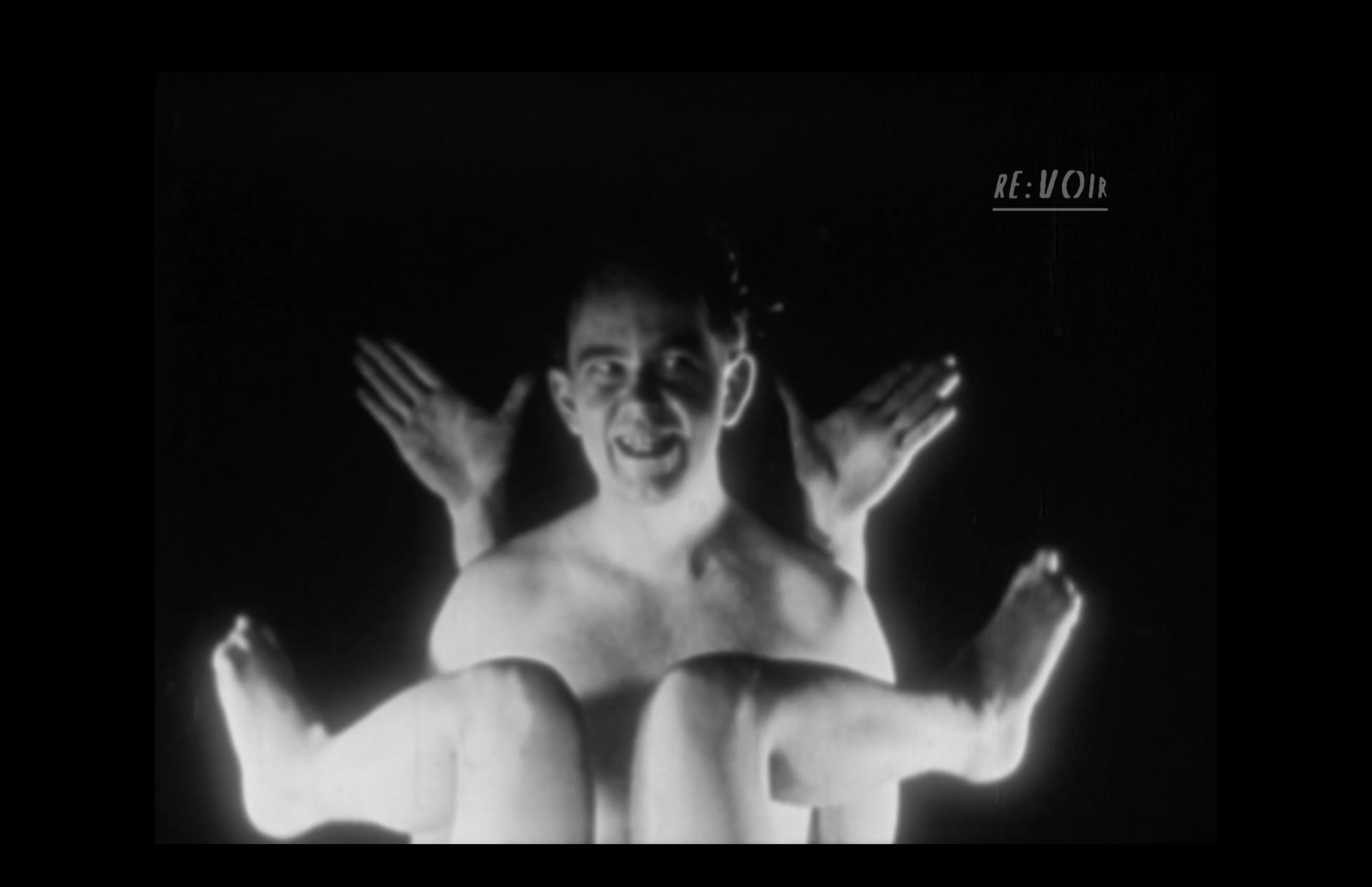
The Body and the Situation
The films in the box set were made from the early 1950s to the early 1960s, after Weiss had settled permanently in Stockholm (born in Germany, he moved to Sweden with his family in 1939 and became a Swedish citizen in 1946).
Titles such as Studie I: uppvaknandet (1952), Studie II: hallucinationer (1952), Studie III (1953), Studie IV: frigörelse (1954), Studie V: växelspel (1955), and Ateljéinteriör (1956, the only color film) clearly reflect the director’s intense interest in visually depicting the human form. Each film explores the body as an active agent, creating figurative tensions—sometimes leading to disarticulation of the posed figure (Studie II, Studie IV, and Studie V), or distorting the scenic space itself (Ateljéinteriör).
The collection also features works like Ansikten i skugga (1956), Ingenting Ovanligt (1957), Enligt lag (1957), Vad ska vi göra nu då (1958), and Tagning narkomaner (1960), which portray broader social realities. Several of these films were commissioned to focus on problematic situations: marginalization (Ansikten i skugga), road accidents (Ingenting Ovanligt), juvenile detention (Enligt lag), youth issues (Vad ska vi göra nu då), and drug addiction (Tagning narkomaner). Weiss’s social explorations are layered, balancing detailed sociological observation with fleeting moments of lyrical openness, offering a perspective that transcends simple thesis-driven narratives.
Laboratory
As noted earlier, the Re:Voir collection offers valuable insights into Weiss’s view of the moving image. For example, an interview with his third and final wife, Gunilla Palmstierna-Weiss—conducted by Martin Grennberger and Stefan Ramstedt and included in the box set booklet—reveals various technical and personal details, especially Weiss’s cinephilia and his work as a film critic. Notably, he contributed to respected Swedish publications such as Filmfront, Filmjournalen, and Biografbladet, and in 1956 published Avantgardefilm—a book of reflections on cinema that has been translated into French.
An examination of his films alongside his writings reveals points of connection, allowing us to see filmmaking as a laboratory where initial ideas and tendencies may have developed. Films grounded in realism can be linked to his later theater work, particularly in the evolving concept of documentation—reflected in his character portrayals, often related to social identity, and in the mise-en-scène, designed to visually convey ongoing actions. Conversely, Weiss’s surrealist approach to the human form suggests that the “figurative side” in his writing is a longstanding, inherently intermedial trait. An example is the depiction of Zeus’s altar at the Pergamon Museum in Berlin—the opening and central scene of The Aesthetics of Resistance—which might also symbolize the author’s worldview. Linking the films about the body to the trilogy’s opening pages reveals the depth of an existentialism in which the particular and the universal are intimately intertwined.
The Other Writing
Lastly, Weiss’s films merit examination and recognition because they offer an additional case study in the history of the relationship between writing and cinema. While adaptations of novels and the writers who produce narrative films within relatively established production systems have consistently—and appropriately—received substantial critical attention, what should be said of writers who have engaged directly in cinematic experimentation? Figures such as Cocteau, Agee, Hillarp, Isou, Debord, Mishima, Burroughs, and Perec come to mind. In contemporary discourse, the author of Marat/Sade and The Investigation should also be included. The pertinent question then becomes: where should this individual be situated within the evolution of experimental film?
Based on an interview Farocki conducted for the German magazine Filmkritik (1980)—Farocki having previously created the film Zur Ansicht: Peter Weiss (1979)—it is known that Weiss’s cinephilia also embraced Cocteau’s cinema. Following this insight and adhering to a chronological approach, one might suggest that Weiss’s films exhibit a tension between an interest in avant-garde completeness, exemplified by films such as Le Sang d’un poète (Cocteau, 1930), and an intrinsic tendency toward capturing the essence of immediacy, the sketch, and the unfinished. Reflecting on developments during those years in American and Western alternative cinema, it can be posited that this inclination foreshadows a concept of “making cinema” that becomes increasingly less about adherence to a specific canon and more about an exercise aimed at fostering a new way of seeing, perceiving, grasping, and comprehending the phenomenon before us.
This is a revised version of an article originally written in Italian and published in Alias, the weekly magazine of Il manifesto.
 ISTRUMENTI
Leave a comment